Tag: inclusion

  • Beth tells all – five things that shaped my life

    girl in pastel dress with hairbow sits on floor

    Okay, this won’t be telling all but I hope some will find out more about me I think. Here come five things that shaped my life.

    1. As a child I read a lot of books and was always imagining. Books were like a lifeline for me, where I could escape on magical adventures. I was always having ideas for poems, stories, songs and plays in my head. So that is where I got my love of writing from.
    2. When I was 15, I was in intensive care on life support for 2 months. It took some work to get the images and sounds of the machines out of my head. I turned the trauma into an art piece at university – for which I got a B.
    3. I only passed my GCSE’s with 3 c’s – and got E’s for maths and science having to resit. The rest of my grades were between C and E. And I scraped through my university degree with a 2-2. So while the others were celebrating their exam results, it was harder for me. How did this shape me? It reinforced my ideas of what I was good at, and what not so.
    4. Having to face a lot of social rejection and bullying has made me more adamant to fight this. I have been quite vocal for disability and lgbtq inclusion, and challenging hate during my life.
    5. When I was 13 I found a local am dram group and joined for the pantomime. Acting has always been something I absolutely love. What a surprise I got with a birthday in pantomime week though. I got pulled back on for the birthday song.

  • The Elephant in the room- Disability and mental health

    The Elephant in the room- Disability and mental health

    Photo by Madison Inouye on Pexels.com

    It’s time to talk about another big issue. Don’t worry though, not all the news is bad. Did you know people with disabilities have a higher chance of developing mental health issues?

    decorative image of hand trying to grasp a bright light
    Photo by Luca Nardone on Pexels.com

    This data comes from disability charity, Sense. You can see more about Disability and mental health – Sense

    In 2023, we asked people with complex disabilities about their health and wellbeing, including questions about their mental health. We found that:

    • People with complex disabilities are four times as likely to say their general health is bad or very bad (25%) compared to the general public (5% according to the 2021 general census). 
    • On average, people with complex disabilities have lower happiness levels (6.02) compared to non-disabled people (7.45), according to figures from the Office for National Statistics).
    • Those with complex disabilities have higher average rates of anxiety (5.09) compared to non-disabled people (3.12).

    Additional research also shows that:

    • 30% of people in the UK live with one or more long-term physical health conditions, over 26% of which also have a mental health problem.
    • 70% of disabled people say that social isolation affects their mental health and wellbeing.
    Photo by Suzy Hazelwood on Pexels.com

    Personal Talk

    I’ve certainly found disability adding to my struggles in life, or is it down to social barriers?

    Being disabled has left me feeling like a burden on others and unsure of my abilities. I don’t choose to be like this but it is my reality.

    go outside for mental health, the issue for me is having somewhere fun to go. I have found it difficult to make friends or find community locally because am so different to others.

    Yes, there are people who value you and consider themselves friends, but can’t relate to me or my life. There is help though.

    Photo by Madison Inouye on Pexels.com

    Self Care

    There are lots of ways people can care for and support themselves. What works for some may not work for others.

    Many people will say going out and being in nature helps them. The issue for me is having somewhere fun to go. I have found it difficult to make friends or find community locally because am so different to others.

    I use other ways to care for myself. These include watching cartoons, gaming, getting myself a treat, watching a movie and writing/ drawing/ creating.

    Find what works best for you.

    decorative image of rainbow and clouds

    Resources

    • GP/ NHS app – if you are struggling it is best to get in touch. There are waiting lists for support, but each council has some available for free. You could also get social prescribing through them.
    • Wellbeing apps like Headspace and Calm help with practicing mindfulness. There are also phone journals to document thoughts.
    • Samaritans – this charity runs a 24 hour mental health line
    • Action for happiness – this group offers a wide range of online resources, and run courses across the UK.
    • Mind – one of many mental health charities operating in Britain
    • Specialist counselling for disabled people

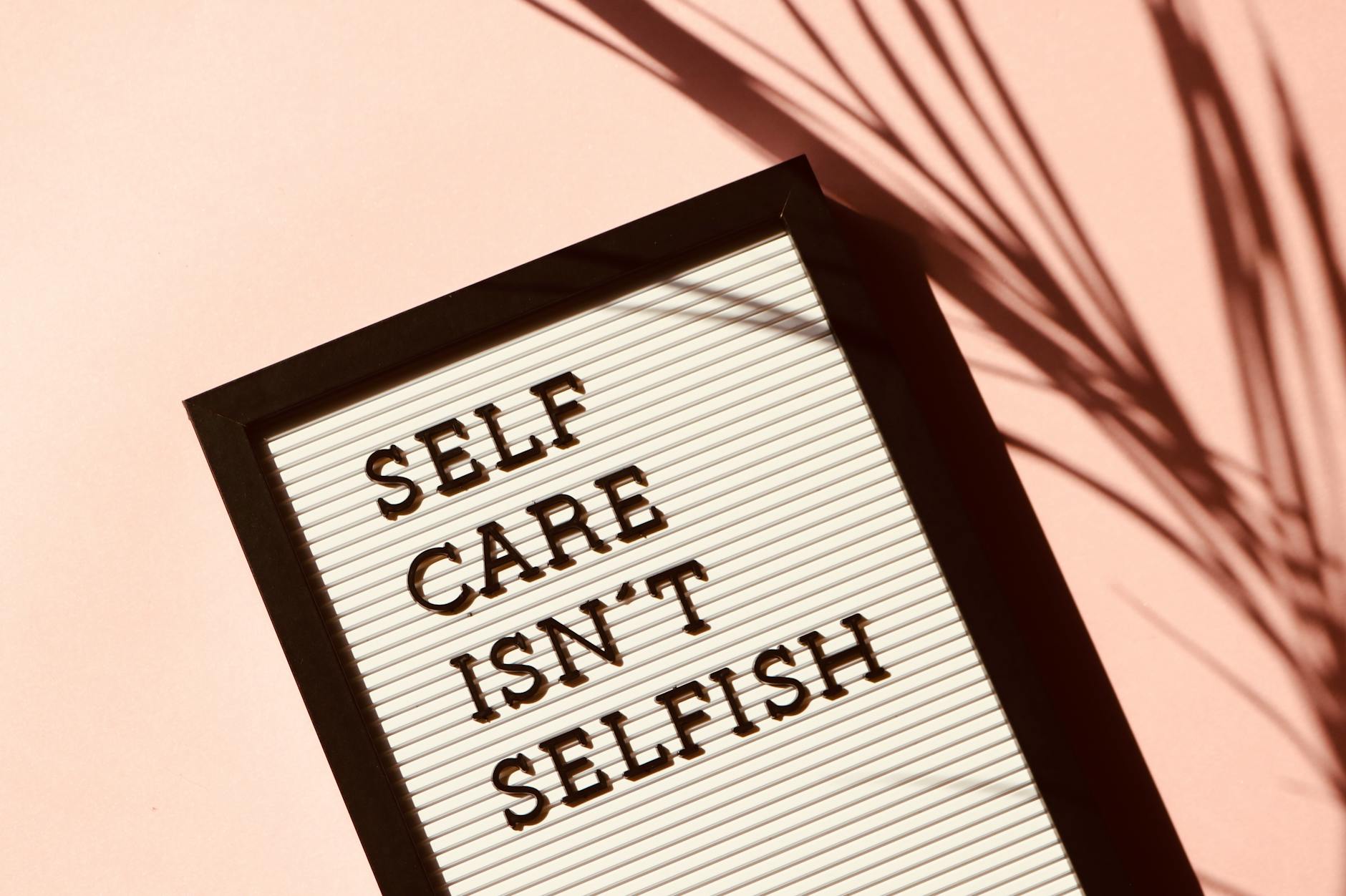
    The bottom line to act on here is to reach out, and self care is not weak.

  • Access to work

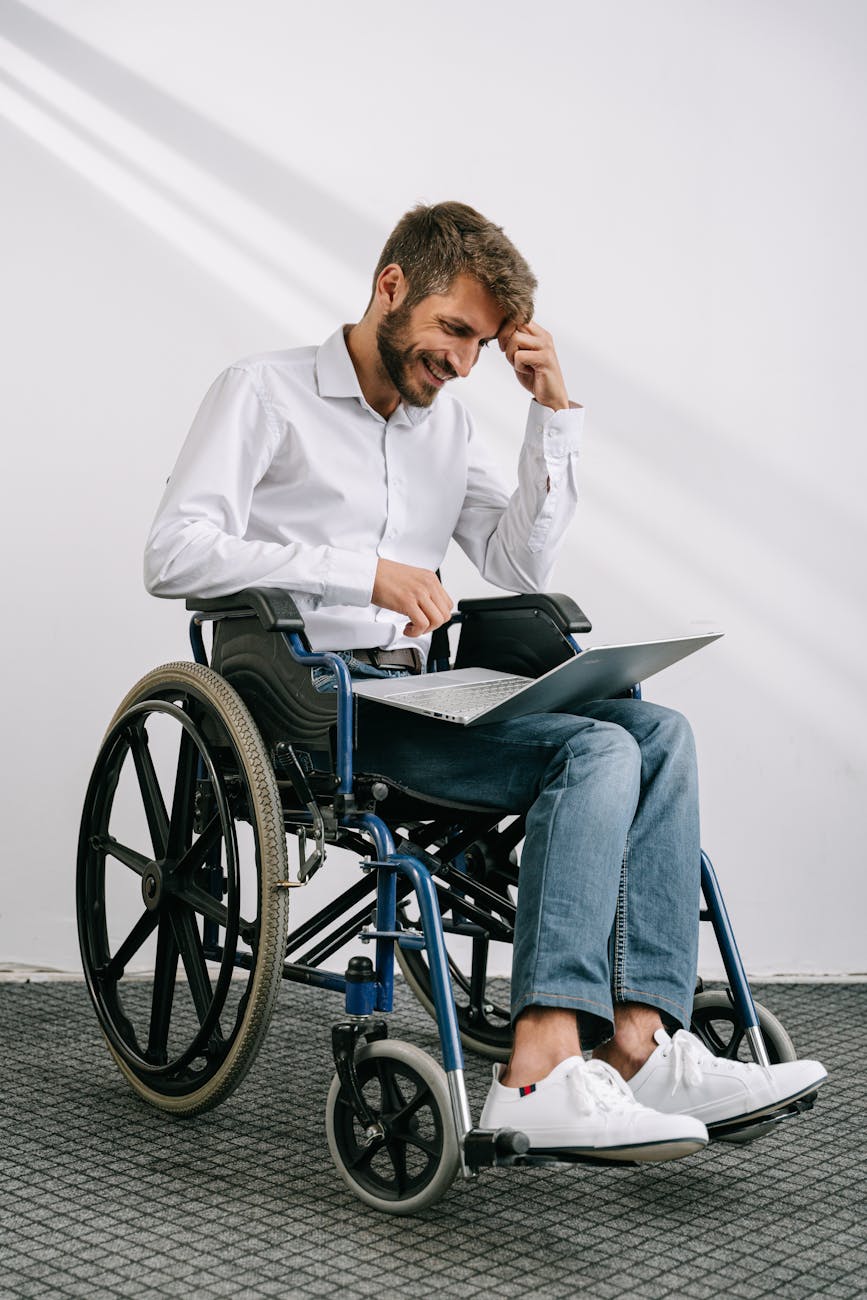
    wheelchair bound worker uses chair to support laptop
    Photo by Ivan Samkov on Pexels.com

    I don’t talk much about my work, but I have a part time administration job. Some of you who read this know who I work for. As this blog is not connected to work and office, I won’t say much.

    What I can tell you is I have had several public speaking opportunities on disability employment.

    decorative image of lightbulb

    There has a been large push to get more disabled into work, but it doesn’t look at the largest barrier. That is social attitudes and unconscious bias.

    Stop sign illustrating a barrier
    Photo by Mwabonje Ringa on Pexels.com

    I searched for work 6 years after leaving university before going to a specialist disabled recruitment agency.
    Why didn’t I join them sooner? I don’t like being given a label or told to join the other disabled people. I was desperate to be included, and not segregated.

    decorative image of hand trying to grasp a bright light
    Photo by Luca Nardone on Pexels.com

    The work pays but not enough for me to save a great deal. Actually, I need to have benefits on top. There isn’t a way a disabled person can get into work without specialist recruitment agencies. If the disabled person wants to change jobs, the agencies can’t help them unless unemployed.

    The action here is to think about how we can change the social bias on disability employment. If you want to change the situation, you need a plan.

  • Accessible content – getting through barriers

    Photo by Mwabonje Ringa on Pexels.com

    Thanks for staying with me.

    We can’t talk about access, without looking at the things that prevent it, blocks and barriers.

    Ask any disabled person, I expect you will find that they have come against blocks/barriers in their life.

    Some places try to improve this and will consult with learning disabled on how things can be done better. I see a few companies putting in positive employment schemes to help disabled workers join or advance. That’s brilliant help.

    Let’s talk about how we manage through barriers without the help there.

    It’s important that we speak out and explain the issues that we have. After all, if we can’t explain the problem or barrier, how can others help us through it?

    I challenge you to think about the blocks and barriers in front of you. Write them down, list the areas and explain how you would like others to help you through.

  • What is Accessible Content?

    A question mark made of tiny buttons on a yellow background.
    Photo by Anna Shvets on Pexels.com

    Let’s start with what access means first.

    Many people in the world can achieve some things they want to, but not all. And sometimes that is down to lack of access.
    Google defines access as “the means or opportunity to enter or approach a place” but that is simplistic. To me, access also refers to permission to use a resource or take in information.

    A stop sign  on a highway, referencing blocked access.
    Photo by Mwabonje Ringa on Pexels.com

    In short there are different types of access, and different needs. Sometimes it’s about being getting into a place, as the definition suggests.

    As a person with learning disabilities, and neurodiverse status this is how I see access.
    With access, I can reach the same goals and outcomes, as everyone else.

    Hand reaching to lightbulb, symbolizing access is reachable.
    Photo by Luca Nardone on Pexels.com

    Wouldn’t it be perfect if everyone got the same education, jobs, housing, and community.
    (Spoiler alert -if that sounds like a fantasy it is one but society could change one day. For now, the pursuit of access is a reality.)

    Picture of blue sky with words Future coming through it
    Photo by Tara Winstead on Pexels.com

    What happens when you don’t have access? You can’t get to the same places or do the things that others can. This is the reality of life without access. To highlight this point let me tell you my own story of getting work as a disabled person.

    Photograph of the author, Beth Birley

    After I graduated university, it took 6 years to get a job. To get there meant having to be put in a disabled box in the end. As someone who would much rather fit in it felt soul destroying. I had to concede it was the only way.  This disabled box though was a specialist employment agency that got me my first proper job.


    Between university and getting a job I did temp work for a bit through an agency. One of the most devastating experiences was when the agency sent me to do an admin for a company. I thought I was getting everything right but half an hour later I was sent home. Can you imagine what that feels like?

    So now you perhaps get a bigger picture on why access is important. Let’s move on to accessible content.

  • The importance of Inclusion

    Photo by Diva Plavalaguna on Pexels.com

    Some of you are already groaning, she is getting to get political I expect. Well, I certainly attend to look at the issue. Inclusion is something I have had mixed experiences with, mostly they were good though.

    So what does inclusion mean? So the work of inclusion is there so everyone can join who wants to. When this happens sometimes other people are pushed out, but that should not be how it works.

    So let’s look at an example.

    I want you to imagine that you are a child at new school. One of the popular kids in class is inviting everyone to a party, and they add you also. How is it going to feel?

    In reverse now we can all see exclusion. You live with a bunch of university mates who always go out. But you never get invited along, and if you ask they say you don’t fit. How do you think this feels?

    This should explain one reason inclusion is important.